
______________________________________________________________
Do you often struggle to turn your thoughts into clear and meaningful sentences? Stay calm because strong writing does not come from natural talent alone. You can improve it through small and consistent actions.
Learning how to improve your writing skills through daily practice can help you write with more confidence, clarity, and speed. You do not need to spend several hours at your desk every day. Even 20 to 30 minutes of focused practice can produce noticeable results over time.
This guide will cover practical exercises that can strengthen your vocabulary, grammar, sentence structure, creativity, editing skills, and personal writing style. You will also learn how to create a useful routine and avoid common mistakes that slow your progress.
How to Improve Your Writing Skills Through Daily Practice
Daily practice gives you regular opportunities to test new ideas, correct mistakes, and develop better habits. You can improve faster when you follow a clear routine instead of writing only when inspiration appears.
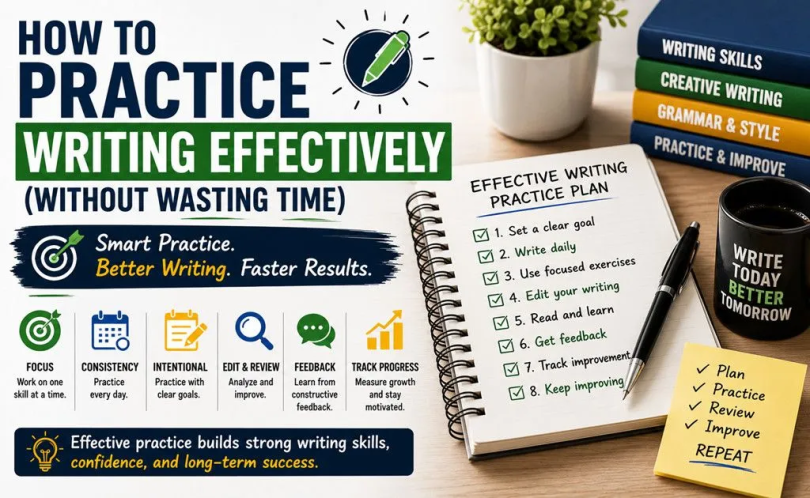
The following methods can help you develop your skills step by step:
- Set a Daily Writing Goal
- Keep a Personal Journal
- Read Every Day
- Practice Freewriting
- Learn New Words
- Rewrite Strong Content
- Focus on One Skill at a Time
- Edit Your Own Work
- Ask for Helpful Feedback
- Track Your Progress
1. Set a Daily Writing Goal
A clear daily goal gives your practice direction. You can decide to write for 20 minutes, complete 300 words, or finish one short paragraph every day. Choose a goal that fits your routine and feels easy to maintain.
Do not set a difficult target at the beginning. A large target may make you feel tired or discouraged after a few days. Start with a small goal and increase it as your confidence grows.
Write at the same time each day whenever possible. A regular schedule helps your mind prepare for the task. You can write in the morning, during a lunch break, or before going to bed.
Focus on completing the practice instead of creating perfect sentences. Regular effort matters more than perfection. Your skills will develop naturally when you continue showing up.
Simple daily goals may include:
- Write 200 words about your day.
- Complete one short product description.
- Write for 20 minutes without stopping.
- Create one introduction for a blog post.
- Describe one object in detail.
- Write a short opinion about a current topic.
2. Keep a Personal Journal
A journal gives you a private space to express your thoughts without pressure. You can write about your day, goals, challenges, ideas, or emotions. This freedom helps you develop a more natural writing voice.
You do not need to follow strict grammar rules during the first draft. Focus on expressing your thoughts clearly. You can review the entry later and improve weak sentences.
Journal writing also helps you understand how you organize ideas. You may notice repeated words, unclear thoughts, or long sentences. These patterns show you which areas need more attention.
Try to include details instead of writing general statements. Describe what happened, how you felt, and what you learned. Specific details make your writing more engaging.
Over time, your journal will show how your style and confidence have improved.
You can write about:
- A lesson you learned today
- A difficult decision
- A future goal
- A memorable conversation
- A place you visited
- A problem you solved
- Something that made you happy
3. Read Every Day
Reading exposes you to new words, sentence patterns, ideas, and writing styles. It shows you how experienced writers explain information and hold a reader’s attention. Regular reading can improve your writing without making the learning process feel difficult.
Choose material from different sources. Read books, blog posts, news articles, essays, stories, and professional guides. Each format can teach you something different.
Pay attention to how writers begin their work. Notice how they connect paragraphs and explain difficult ideas. You should also study how they use examples, questions, and descriptive language.
Do not copy another writer’s voice completely. Instead, identify useful techniques and apply them in your own way. Your goal should involve learning, not imitation.
Keep a notebook nearby and record new words or sentence structures that catch your attention.
While reading, notice:
- How the writer opens the topic
- How each paragraph supports the main idea
- Which words make the message clear
- How the writer uses examples
- How headings organize the information
- How the conclusion closes the discussion
4. Practice Freewriting
Freewriting means writing continuously for a fixed period without stopping to edit. This exercise helps you overcome fear, hesitation, and overthinking. It also trains your mind to produce ideas more quickly.
Choose a topic and set a timer for 10 or 15 minutes. Write every thought that comes into your mind. Do not correct spelling, grammar, or sentence structure during the exercise.
You may produce several weak sentences, but that does not matter. The goal involves building flow and confidence. You can review the material afterward and find useful ideas.
Freewriting can also help when you face a blank page. It gives you raw material that you can shape into a stronger draft. Many good ideas appear after you stop trying to sound perfect.
Practice this exercise several times each week to improve your writing speed.
Freewriting topics may include:
- What success means to you
- A skill you want to learn
- Your perfect working environment
- A problem in your industry
- A childhood memory
- A recent achievement
- Your opinion about a common habit
5. Learn and Use New Words
A strong vocabulary helps you express ideas with greater accuracy. However, you do not need to use difficult or unusual words to impress readers. The best word usually communicates the meaning in the clearest way.
Learn two or three useful words each day. Read their definitions and study how other writers use them. Then create your own sentences with those words.
Review your new vocabulary at the end of each week. Regular revision helps you remember the words and use them naturally. You can also group words according to topics, such as business, education, health, or marketing.
Avoid forcing new words into sentences where they do not fit. Natural language always sounds stronger than complicated language. Use each word only when it improves clarity.
A personal vocabulary notebook can make this practice easier.
For each new word, record:
- The correct meaning
- A simple example sentence
- A synonym
- An opposite word
- The word’s common form
- One sentence from your own experience
6. Rewrite Strong Content in Your Own Style
Rewriting helps you understand how strong content works. Choose a short article, advertisement, email, or paragraph that you enjoy. Read it carefully and identify its main message.
Close the original source and explain the same idea in your own words. Change the structure, examples, and tone. Do not replace only a few words because that can lead to copying.
Compare your version with the original after you finish. Notice which version explains the idea more clearly. Study the words and transitions that make the original effective.
This exercise teaches you how to organize information without stealing another person’s work. It also helps you develop flexibility because you can present one idea in several ways.
Practice rewriting different formats so you can adjust your style for different audiences.
You can rewrite:
- A short blog introduction
- A product description
- A business email
- A social media caption
- A news summary
- A customer review
- A short advertisement
7. Focus on One Writing Skill at a Time
Trying to improve every skill at once can make practice confusing. Choose one area and focus on it for several days. You might work on sentence length during one week and paragraph structure during the next.
A focused approach makes your progress easier to notice. It also helps you understand exactly what causes a problem. For example, you may discover that your sentences feel unclear because they contain too many ideas.
Create exercises around the skill you want to develop. If you want stronger introductions, write five different openings for the same topic. If you want better descriptions, describe one place through sight, sound, smell, and emotion.
Review your results at the end of the week. Keep practicing the skill when you still find it difficult. Move to another area when you feel more confident.
Small improvements will combine and strengthen your overall ability.
Useful skills to practice include:
- Clear sentence structure
- Strong introductions
- Logical paragraph order
- Smooth transitions
- Correct punctuation
- Active voice
- Descriptive language
- Powerful conclusions
8. Edit Your Own Work
Writing a first draft and editing it require different skills. The first draft allows you to develop ideas, while editing helps you improve clarity and accuracy. Do not try to complete both tasks at the same time.
Finish your draft and take a short break before reviewing it. A fresh mind will help you notice mistakes more easily. Read each sentence and ask whether it supports the main point.
Remove repeated ideas and unnecessary words. Shorten sentences that feel difficult to understand. Replace weak verbs with direct and active ones.
Read the content aloud because your ears can catch problems that your eyes may miss. You will notice awkward phrases, missing words, and unnatural rhythm. Make another revision after reading it aloud.
Strong editing can turn an average draft into a useful and professional piece.
Use this editing checklist:
- Does the opening create interest?
- Does every paragraph cover one main idea?
- Do the sentences use active voice?
- Have I removed repeated information?
- Does each example support the topic?
- Have I checked spelling and grammar?
- Does the ending feel complete?
9. Ask for Helpful Feedback
Feedback shows you problems that you may not notice on your own. Ask a teacher, editor, colleague, friend, or experienced writer to review your work. Choose someone who can give clear and respectful advice.
Tell the reviewer what kind of feedback you need. You may ask about grammar, structure, tone, clarity, or reader engagement. A specific request usually brings more useful comments.
Do not treat corrections as personal criticism. Every mistake gives you a chance to improve. Study the feedback and look for patterns that appear repeatedly.
Apply the suggested changes yourself instead of asking someone else to rewrite everything. This process helps you understand the reason behind each correction.
Keep a list of common mistakes and review it before starting your next project.
Ask reviewers questions such as:
- Which section feels unclear?
- Does the introduction create interest?
- Do the ideas follow a logical order?
- Which sentences feel too long?
- Does the tone suit the audience?
- What information should I add or remove?
Professional Learning Tip: Digital Applications (dgaps.com) offers a practical content writing course for people who want structured training. Engr. Ghulam Abbas, an expert in this field, teaches with his experienced team through practical tasks and detailed reviews. Their training helps learners understand writing techniques, complete real exercises, receive feedback, and improve through regular practice. A structured course for writers can provide useful direction when independent learning feels difficult.
10. Track Your Writing Progress
Tracking your work helps you see how much you have improved. Keep your early drafts instead of deleting them. Compare them with your recent writing after a few weeks or months.
Look at your sentence structure, vocabulary, clarity, grammar, and organization. You may notice that you now explain ideas more quickly and use fewer unnecessary words. These small changes show real progress.
Create a simple record of your daily practice. Write down the date, exercise, word count, time spent, and main lesson. This record will help you stay consistent.
You can also set monthly goals. For example, you may decide to complete four articles, write 20 journal entries, or learn 50 new words. Clear goals make improvement easier to measure.
Celebrate your progress, but continue identifying areas that need work. Growth comes from regular learning and honest review.
Track details such as:
- Daily word count
- Time spent writing
- Exercises completed
- New words learned
- Feedback received
- Common mistakes
- Monthly achievements
How to Create an Effective Daily Writing Routine
A useful routine should fit your lifestyle and support steady progress. You do not need a complicated plan. A few focused activities can create strong results when you repeat them consistently.
Start by choosing a quiet place where you can work without interruptions. Keep your notebook, laptop, dictionary, and learning material ready. Preparing your space reduces excuses and helps you begin quickly.
Choose a realistic time and protect it from other activities. Turn off unnecessary notifications and focus on one task. A short period of deep attention can produce better results than several distracted hours.
You can use the following routine as a starting point:
- Read for 10 minutes: Study a short article, book section, or professional guide.
- Learn two new words: Record their meanings and use them in original sentences.
- Write for 20 minutes: Complete a journal entry, paragraph, or freewriting exercise.
- Edit for 10 minutes: Review something you wrote on a previous day.
- Study one technique: Focus on transitions, punctuation, openings, or active voice.
- Record your progress: Note what you completed and what you learned.
Adjust the schedule according to your available time. Consistency matters more than the exact number of minutes.
Daily Writing Exercises for Beginners
Beginners often improve faster when they complete short and focused exercises. Each activity below targets a specific writing skill.
- Describe your room: Use clear details to improve observation and descriptive ability.
- Summarize an article: Explain the main idea in five simple sentences.
- Write a short review: Share your opinion about a book, film, product, or service.
- Explain a process: Describe how to complete a familiar task step by step.
- Create a dialogue: Write a short conversation between two people.
- Rewrite a paragraph: Improve the clarity and flow of an old piece.
- Write a headline: Create five titles for one topic.
- Describe an emotion: Show the feeling through actions instead of naming it directly.
- Write for one audience: Explain the same topic to a child and then to a professional.
- Finish a story: Start with one sentence and create a short ending.
Benefits of Practicing Writing Every Day
Daily practice produces several long-term benefits. You may not notice a major difference after one or two days, but regular effort builds important abilities over time.
- Stronger confidence: Regular practice reduces fear and helps you trust your ideas.
- Better vocabulary: Frequent reading and writing introduce useful words naturally.
- Clearer thinking: Writing teaches you how to organize thoughts in a logical order.
- Faster drafting: Practice helps you produce ideas without long delays.
- Improved grammar: Repeated use makes correct structures easier to remember.
- Stronger creativity: Daily exercises encourage you to explore new ideas and perspectives.
- Better editing: Regular review helps you identify weak sentences quickly.
- Natural personal style: Consistent writing allows your unique voice to develop.
- Greater discipline: A daily routine strengthens focus and time management.
- Professional growth: Clear communication supports careers in marketing, education, business, and media.
Common Mistakes That Slow Writing Improvement
Writers often make mistakes that reduce the value of their practice. You can improve more effectively when you identify and avoid these habits.
- Waiting for inspiration: A schedule creates progress more reliably than motivation.
- Setting unrealistic goals: Large targets can lead to stress and inconsistency.
- Editing every sentence immediately: Constant correction interrupts the flow of ideas.
- Using difficult words unnecessarily: Simple language usually communicates more clearly.
- Ignoring feedback: Helpful criticism reveals problems you cannot always see.
- Comparing yourself with experts: Focus on your own progress instead of someone else’s level.
- Skipping reading: Writers need regular exposure to strong language and new ideas.
- Repeating the same exercise: Different activities develop different skills.
- Avoiding weak areas: Practice the skills that create the most difficulty.
- Publishing without revision: Every important piece needs editing and proofreading.
- Giving up too early: Improvement takes time, patience, and repeated effort.
- Writing without a purpose: A clear goal keeps every exercise focused.
How to Stay Consistent With Daily Writing
Consistency can feel difficult when work, study, or personal responsibilities become demanding. A flexible plan can help you continue practicing even on busy days.
Set a minimum target that you can complete in five or ten minutes. You might write 100 words, edit one paragraph, or record three ideas. A small action keeps the habit active.
Use a calendar or habit tracker to record each completed session. Seeing a chain of successful days can motivate you to continue. You can also choose an accountability partner who checks your progress.
Prepare topics in advance so you do not waste time deciding what to write. Keep a list of questions, memories, opinions, and exercises nearby. Select one topic whenever you begin your session.
Do not stop practicing because you miss one day. Return to the routine the next day without blaming yourself.
These habits can support consistency:
- Write at the same time each day.
- Keep your practice materials ready.
- Start with a small daily target.
- Remove digital distractions.
- Prepare a list of topics.
- Record every completed session.
- Reward yourself after reaching a goal.
- Restart quickly after missing a day.
How Long Does It Take to Improve Writing Skills?
Every writer develops at a different pace. Your current level, practice quality, reading habits, and feedback can affect your progress. You should not expect complete improvement within a few days.
You may notice better confidence and faster idea generation after several weeks of regular practice. Stronger grammar, structure, and style may require several months. Advanced skills often develop through years of reading, writing, feedback, and revision.
The quality of your practice matters as much as the amount of time you spend. Writing the same way every day without reviewing mistakes may limit your progress. Focused exercises and thoughtful editing usually produce better results.
Set realistic expectations and measure small improvements. A clearer paragraph, stronger opening, or shorter editing process all show meaningful growth.
Final Note
In this guide, we have covered how to improve your writing skills through daily practice by setting goals, keeping a journal, reading regularly, freewriting, building vocabulary, rewriting strong material, editing, requesting feedback, and tracking progress.
Daily practice does not need to feel difficult or exhausting. A short and focused routine can create meaningful improvement when you follow it consistently. Your small efforts will gradually strengthen your confidence, creativity, grammar, clarity, and personal style.
My personal view is that every writer should focus on progress instead of perfection. Mistakes form a natural part of the learning process. Each correction teaches you something, and every completed paragraph moves you forward.
Keep reading, continue writing, and give yourself enough time to grow. Thank you for reading, and best wishes for your writing journey!