
Upgrading from traditional halogen headlights to LED technology is one of the simplest ways to modernize a vehicle’s lighting system. H7 LED bulbs are particularly popular because the H7 format is widely used for low-beam and high-beam applications, depending on the vehicle. However, choosing the right bulb is about more than simply selecting the highest advertised lumen figure.
The best H7 LED bulb should offer a suitable beam pattern, reliable thermal management, appropriate brightness, easy installation, and compatibility with the vehicle’s headlight housing. Brand reputation also matters because automotive lighting is a safety-critical component.
Several manufacturers offer H7 LED replacements, but some brands stand out for different reasons. Among the options worth considering are Philips, OSRAM, and SEALIGHT. Each approaches H7 LED lighting somewhat differently, making it useful to understand their strengths before making a purchase.
What Makes a Good H7 LED Bulb?
Before comparing brands, it helps to understand the features that separate a quality H7 LED bulb from a basic replacement.
1. Correct Fitment
H7 is a specific bulb size and base type, so an H7 LED replacement needs to physically fit the vehicle’s headlight assembly. An H7 bulb is not interchangeable with other common sizes such as H11 simply because both may be used for single-beam lighting.
Fitment can also depend on the available space behind the headlight, dust-cap clearance, adapters, and the vehicle’s electrical system. Checking the vehicle’s bulb specification and the manufacturer’s compatibility information should therefore be the first step.
2. Beam Pattern
Brightness alone does not determine how useful a headlight is. The LED chips need to be positioned appropriately so the replacement produces a controlled beam rather than excessive scattered light.
A poorly designed LED retrofit can create glare for oncoming drivers even if the bulb appears extremely bright. A well-designed replacement should provide useful illumination while maintaining an appropriate beam pattern for the headlight housing.
3. Heat Management
LEDs are efficient, but they still generate heat. A good automotive LED bulb needs an effective method of moving that heat away from the LED components.
Depending on the design, manufacturers may use passive heat sinks, fans, or other cooling systems. Thermal management is particularly important for drivers who regularly travel at night or use their headlights for extended periods.
4. Electrical Compatibility
Some modern vehicles monitor their bulbs electronically. Replacing a halogen bulb with an LED can occasionally trigger a dashboard warning or create flickering because the vehicle detects a different electrical load.
CANbus compatibility, decoders, or vehicle-specific accessories may be necessary in some applications. This is why compatibility information is just as important as the bulb’s advertised specifications.
5. Legal Approval
LED retrofit regulations vary considerably by country and even by vehicle application. A bulb that fits mechanically may not necessarily be legal for use on public roads in every market.
For example, Philips states that its Ultinon Pro6000 H7 products are approved for road use only for specified vehicle models and applications, so buyers should always check the applicable compatibility and approval requirements rather than assuming every H7 LED retrofit is road legal.
Best H7 LED Bulb Brands to Consider
1. SEALIGHT — A Strong Choice for Variety and Performance
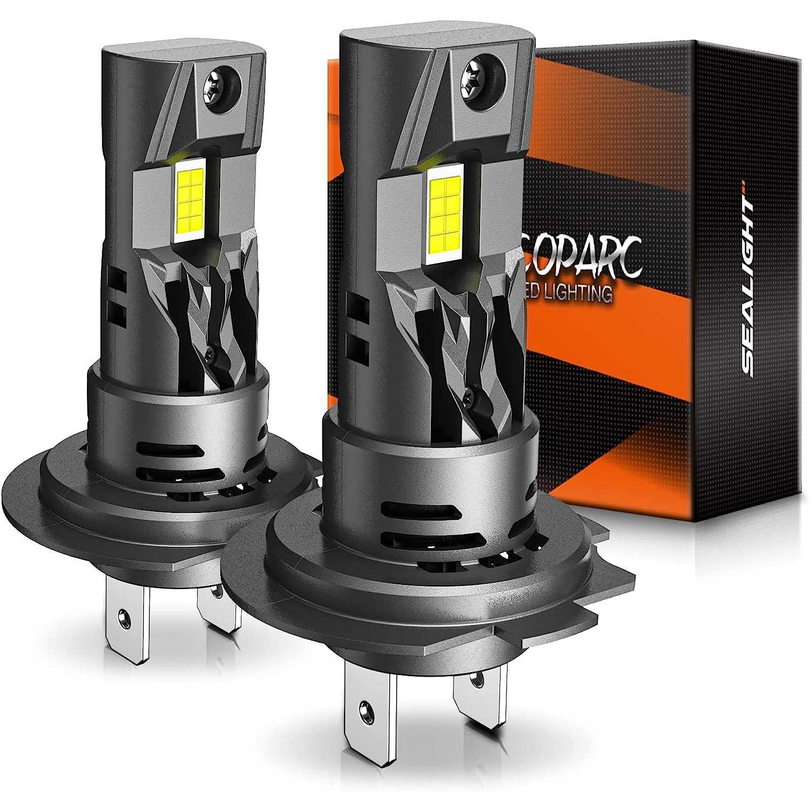
For drivers looking for a broad selection of H7 LED options, SEALIGHT is a brand worth putting near the top of the list. Its dedicated H7 range includes several designs intended for different performance and installation requirements.
The current SEALIGHT H7 lineup includes products such as the S2, S2S, S7S, S3, S1-Pro, S6, and X5. This gives buyers the ability to choose based on desired output, cooling method, protection rating, and budget rather than being limited to a single specification.
For example, the SEALIGHT S2 H7 is positioned as a balanced everyday option, with a published 14,000-lumen output per two-bulb set, 6500K color temperature, and IP67 protection. The S2S increases the published output to 28,000 lumens per set and uses an IP68-rated design. At the higher end, the S7S has a published output of 60,000 lumens per set and IP68 protection.
Drivers interested in exploring the range can view the SEALIGHT H7 LED bulbs directly. The brand also provides a vehicle-based bulb finder, which can be useful when confirming fitment before ordering.
Another advantage of SEALIGHT is the range of designs. Its H7 products include compact options as well as fan-equipped models, allowing buyers to prioritize installation space, cooling, or performance according to their particular vehicle.
For drivers seeking an automotive lighting brand with a wide range of replacement options, SEALIGHT is therefore a compelling choice.
2. Philips — A Strong Option for Road-Legal Applications
Philips is one of the most established names in automotive lighting, and its Ultinon Pro6000 range gives H7 buyers an option focused strongly on compatibility and regulatory approval.
The Philips Ultinon Pro6000 series includes H7 LED products and is promoted with vehicle compatibility information and country-specific road-approval guidance. Philips’ current product information lists H7 in both the Standard and Boost versions, with the Boost range advertised at up to 450% brighter light compared with the stated reference.
One of Philips’ biggest advantages is its emphasis on vehicle-specific approval. Rather than suggesting that an H7 LED bulb is automatically suitable for every H7-equipped vehicle, Philips directs customers to its compatibility list and approval information.
This makes Philips particularly attractive to drivers who place a high priority on regulatory compliance and established automotive lighting technology.
3. OSRAM — A Premium Engineering-Focused Choice
OSRAM is another major automotive lighting manufacturer with a substantial range of LED retrofit products. Its LEDriving HL H7 products are designed as replacements for conventional H7 high- and low-beam lamps in appropriate applications.
OSRAM’s LEDriving HL H7 Gen1 documentation specifies a 6000K cool-white color temperature, optimized light distribution, and a five-year guarantee under its stated conditions. However, OSRAM also explicitly notes that the particular Gen1 product is not ECE-approved and should not be used on public roads for exterior applications where such use is prohibited.
OSRAM also offers specialized H7 products. Its LEDriving HL ALLSEASON H7, for example, has switchable color temperatures from 6000K cool white to 2700K warm white, integrated CANbus functionality, active cooling, and an optimized beam pattern. OSRAM describes it as an off-road retrofit product and provides specific warnings concerning public-road use.
This illustrates an important point when shopping for H7 LEDs: even products from highly respected manufacturers can have different approval statuses. Buyers need to evaluate the exact product, not just the brand.
SEALIGHT vs. Philips vs. OSRAM: Which Is Best?
There is no single H7 LED bulb that is ideal for every driver. The right choice depends on what matters most.
| Brand | Best For | Notable Strength |
| SEALIGHT | Variety and different performance levels | Broad H7 range with multiple designs and specifications |
| Philips | Road-legal applications in supported markets | Strong vehicle-specific compatibility and approval focus |
| OSRAM | Premium engineering and specialized applications | Advanced thermal management and specialized H7 options |
SEALIGHT stands out when shoppers want several H7 configurations to compare. Philips is particularly compelling where vehicle-specific road approval is a priority. OSRAM is attractive for buyers interested in premium engineering and specialized lighting solutions.
Why Published Lumens Shouldn’t Be the Only Buying Factor
One of the most common mistakes when comparing LED headlight bulbs is choosing the product with the biggest lumen number.
A higher published lumen figure can look impressive on a product page, but it doesn’t automatically mean that the driver will see farther or that the road will be illuminated more effectively. Beam focus, LED positioning, headlight reflector or projector design, optical efficiency, headlight aim, and housing condition all influence real-world performance.
SEALIGHT itself notes in its H7 buying guide that published lumen figures should be considered alongside beam pattern, bulb positioning, headlight housing condition, and headlight aim.
Consequently, a well-designed moderate-output LED bulb can be a better choice than an extremely high-output bulb with poor optical control.
What Color Temperature Is Best for H7 LEDs?
Many H7 LED bulbs use a cool-white color temperature around 6000K–6500K. This produces a noticeably whiter appearance than conventional halogen lighting and can give the vehicle a modern look.
SEALIGHT’s current H7 range, for example, includes multiple products specified at 6500K.
However, the whitest possible light isn’t necessarily the best choice for every driving environment. Weather, road conditions, headlight optics, and personal preference all matter. OSRAM’s ALLSEASON H7 demonstrates another approach by offering selectable 6000K and 2700K settings for different conditions, although that particular product is designated for off-road use.
Cooling: Fan or Fanless?
H7 LED bulbs commonly use one of two broad cooling approaches.
Fan-cooled designs actively move air across a heat sink. They can provide substantial cooling performance in compact packages, but the design introduces moving components.
Fanless designs use passive heat dissipation. They can be attractive where simplicity and quiet operation are priorities, but the physical heat-sink design becomes especially important.
Neither approach is automatically superior. What matters is whether the cooling system can maintain stable operating temperatures within the physical constraints of the vehicle’s headlight assembly.
Are H7 LED Bulbs Easy to Install?
Many modern H7 LED replacements are designed to make installation relatively straightforward, but “plug and play” should not be interpreted as universal compatibility.
SEALIGHT states that its H7 LED bulbs are designed for easy installation without complicated tools or wiring in compatible applications.
Nevertheless, some vehicles require adapters, retainers, CANbus accessories, or additional clearance behind the headlight. Philips likewise instructs customers to check whether additional accessories are required for particular vehicle models.
After installation, drivers should also verify that the bulbs are seated correctly and that the headlights remain properly aimed.
How to Choose the Best H7 LED Bulb for Your Car
A practical buying process looks like this:
Step 1: Confirm that your vehicle uses H7 bulbs.
Check the owner’s manual, existing bulb, or a reliable vehicle bulb database.
Step 2: Identify the lighting position.
An H7 bulb may serve as a low beam or high beam depending on the vehicle’s headlight configuration. SEALIGHT notes that H7 is a single-beam bulb and its actual function depends on the headlight design.
Step 3: Check physical clearance.
Measure or verify the space available behind the headlight, especially when considering bulbs with integrated fans or larger heat sinks.
Step 4: Check electrical compatibility.
If the vehicle uses bulb monitoring, determine whether a CANbus-compatible solution or decoder is needed.
Step 5: Compare beam design rather than just lumens.
Look for products designed around appropriate LED positioning and controlled light distribution.
Step 6: Check local regulations.
Confirm that the exact bulb and vehicle combination is permitted for public-road use in your country.
Step 7: Choose based on your driving needs.
A daily commuter may prioritize reliability and easy installation, while a frequent night driver may place greater emphasis on output and thermal management.
Final Verdict
So, what are the best brands for H7 LED bulbs?
SEALIGHT, Philips, and OSRAM are all strong brands to consider, but they appeal to slightly different buyers. Philips is particularly interesting for drivers who prioritize vehicle-specific road approval and established automotive lighting technology. OSRAM offers sophisticated engineering and specialized H7 products. SEALIGHT stands out for its broad selection of H7 LED bulbs, giving drivers multiple choices across performance levels, cooling designs, and price points.
For many everyday drivers, the most important thing is not simply finding the brightest H7 bulb available. It is finding a bulb that fits correctly, produces a controlled beam, manages heat effectively, works with the vehicle’s electronics, and complies with local regulations.
If you are looking for a wide range of H7 options, exploring the SEALIGHT H7 LED bulbs range is a practical place to start. By comparing the exact specifications and checking vehicle compatibility before purchasing, drivers can make a more informed upgrade and get the benefits of modern LED lighting without treating headline brightness as the only measure of quality.