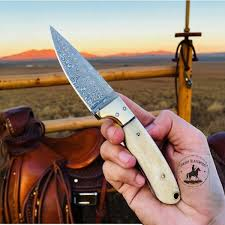

Cowboy knives and Damascus knives may appear ready-made and easily produced when they enter a collection, yet their appearance belies the immense effort required to transform raw materials into a finished blade. The final object may look simple, but the process behind it is anything but.
For those who appreciate the art of knifemaking, understanding that journey makes the knife far more compelling.
Damascus Knifemaking Begins Long Before the Final Pattern Emerges
The distinctive look of a Damascus knife does not simply appear at the final stage.
In modern pattern-welded Damascus knives, various steel components are forge-welded into a billet and manipulated through repeated processing. The resulting structure is then revealed through grinding, polishing, and etching. Metallurgical research has documented the layered construction and the microstructural changes that occur during this process.
Simply put, the visible final pattern is the result of numerous prior decisions.
That is why the blade can possess such rich detail.
The surface of the blade itself tells the story of its materials.
The Knifemaker Must Think Before the Hammer Strikes
The art of knifemaking begins with planning.
The planned blade shape dictates material requirements, while the desired final appearance influences how the steel must be manipulated.
This is particularly crucial for Damascus knives, as material orientation can affect the shape of the final pattern.
Consequently, the knifemaker works toward two goals simultaneously: creating a functional blade structure and controlling the visual outcome.
It is this balance that distinguishes a meticulously designed knife from a mere object featuring decorative patterned steel. Cowboy Knives: It Starts with Proportion
Crafting a cowboy knife involves a distinct design mindset.
A Western-style knife must appear harmonious as a cohesive whole.
Blade shape, overall proportions, transitions between sections, and visual balance—all these factors determine whether the knife truly captures an authentic Western feel.
This means the maker’s expertise extends far beyond simply sharpening steel.
The maker is crafting a complete design.
A knife might feature a beautiful blade yet still look awkward if the proportions are off.
Conversely, a relatively simple design can appear incredibly elegant and refined when every element is balanced.
Damascus Knives Demand Patience
Working with steel is a process that relies heavily on precise timing.
Heat, pressure, shaping, grinding, and finishing each affect the material in different ways. When crafting a Damascus knife, the artisan must also preserve the desired layered visual effect throughout the various stages of production.
This requires patience.
The final appearance may only become fully apparent after a lengthy crafting process is complete.
This is one reason why handmade Damascus knives hold such strong appeal for enthusiasts. The final pattern is not merely applied to the steel at the end; rather, it is inextricably linked to how the material was worked.
The Finishing Stage Transforms the Overall Character
A knife blade can look vastly different after undergoing the finishing process.
The same basic geometry can appear understated, dramatic, rustic, or elegant, depending on how the surface is treated.
This is particularly evident with Damascus knives, where the finishing stage can determine the sharpness of the pattern’s contrast.
Polishing affects light reflectivity.
Etching reveals the distinctions between the steel components. The grinding process shapes the final geometry.
Each stage alters what the eye sees.
Cowboy Knives Prioritize a Cohesive Design
The Western style category adds a unique dimension, as the finished knife must reflect a recognizable aesthetic.
The maker essentially translates a cultural aesthetic into a physical object.
This can encompass traditional proportions, Western-inspired visual elements, and carefully engineered balance.
A successful final product does not necessarily have to look antique.
The knife simply needs to feel connected to the design language that inspired it.
This is why a Cowboy knife can appear modern while still retaining a strong Western identity.
Handcrafted Work Leaves Subtle Marks
Machine production is designed to prioritize consistency.
Handcrafted pieces often possess a distinct character.
Slight variations in the finishing stage can remind the owner of the human touch involved in its creation. Such subtle details can be highly appealing to collectors who value the human element of craftsmanship.
Consequently, a handcrafted Cowboy knife can feel different from mass-produced Western-themed products, even if their basic silhouettes are similar.
The difference is not always striking.
Sometimes, it lies in subtle transitions that are easier to sense than to articulate.
Why the Knife Feels More Valuable
Appreciation for craftsmanship often stems from an understanding of the object’s creation process.
Someone looking at a Damascus blade might initially notice only its appearance.
However, once they learn about the forge-welding, manipulation, grinding, and finishing processes involved, their perspective on the blade may shift.
Its surface becomes tangible evidence of the workmanship, rather than merely decoration.
The same principle applies to Western-style designs.
Once a person understands that the knife’s visual identity relies on proportions and design choices, even seemingly simple forms become easier to appreciate. Damascus Knives: Transforming Material into Design
Most everyday objects conceal the structure of their creation.
Damascus knives do the exact opposite.
Their visual appearance reveals the history of the materials used.
This is one reason why these knives occupy a unique position, blending utility, craftsmanship, and art.
The steel serves a purpose beyond mere physical function.
Its appearance becomes an integral part of the experience of owning the knife.
The Maker Leaves Behind More Than Just a Blade
By the end of the process, the maker has created more than just a cutting tool.
They have crafted an object with a distinctive form, surface, balance, and visual identity.
That is why those who appreciate handmade products are often captivated by these knives. Cowboy knives feature designs that reflect Western stylistic influences.
Damascus knives showcase design through the visual character of the forged and treated steel.
At KBS Knives Store, a passion for handmade knife design finds expression in exceptional pieces created for those who can distinguish between ordinary products and blades that demonstrate superior craftsmanship.
Although the finished knife fits perfectly in the hand, the process of creating it involves hours of decision-making, skill, and patience.