

When people hear the term “non-profit,” they often think of charities, donations, or social work. While that is partly true, a non-profit organization is much broader than just charity-based activity. It plays a major role in education, healthcare, community development, environmental protection, and even research and advocacy.
In simple words, a non-profit organization is an entity that operates for a purpose other than making profits for owners or shareholders. Instead of distributing earnings, it reinvests them into its mission and activities.
This article explains what a non-profit organization is, how it works, its types, benefits, challenges, and why it matters in today’s world.
Meaning of a Non-Profit Organization
A non-profit organization is a legal structure formed to serve a public or social benefit rather than to generate profit for individuals.
Any income generated by the organization is used to:
- Fund its programs
- Pay operational costs
- Support its mission
Unlike businesses, where profits are distributed among owners or investors, non-profits reinvest everything back into their goals.
For example, if a non-profit runs a school, any fees or donations received will be used to improve education, pay teachers, and maintain facilities—not to enrich owners.
Key Features of Non-Profit Organizations
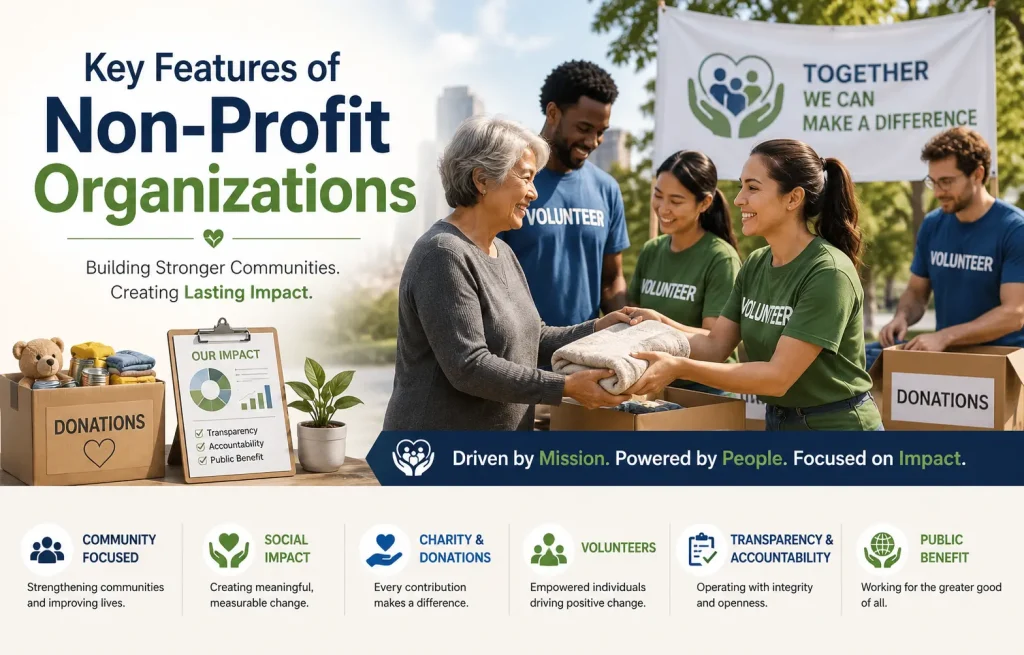
Non-profits have some unique characteristics that set them apart from businesses:
1. Purpose-Driven Mission
Every non-profit is built around a specific mission, such as helping the poor, protecting the environment, or promoting education.
2. No Profit Distribution
Even if the organization earns extra money, it is not shared among members or leaders. It is reinvested into programs.
3. Volunteer and Donation-Based Support
Many non-profits rely on volunteers, grants, and donations to operate.
4. Tax Benefits
In many countries, non-profits receive tax exemptions because they serve public interest.
5. Accountability and Transparency
They are required to maintain clear financial records and report how funds are used.
How Does a Non-Profit Organization Work?
A non-profit works similarly to a business in terms of structure and operations, but its goals are different.
Here’s a simple breakdown:
1. Funding Sources
Non-profits get money from:
- Donations from individuals
- Government grants
- Corporate sponsorships
- Fundraising events
2. Budget Allocation
The money is allocated to:
- Program development
- Staff salaries
- Operational costs
- Outreach activities
3. Execution of Programs
They implement projects aligned with their mission, such as:
- Building schools
- Running awareness campaigns
- Providing healthcare services
4. Reporting and Compliance
They regularly report their financial activities to ensure transparency and maintain trust.
Types of Non-Profit Organizations
Non-profits come in many forms depending on their purpose.
1. Charitable Organizations
These focus on helping underprivileged people through food, shelter, education, or healthcare.
2. Educational Institutions
Schools, colleges, and training centers that operate on a non-profit basis fall into this category.
3. Religious Organizations
Many religious groups operate as non-profits to support spiritual and community services.
4. Health Organizations
Hospitals, clinics, and medical research institutions that serve public health needs.
5. Environmental Groups
These organizations work to protect nature, wildlife, and promote sustainability.
6. Cultural and Sports Organizations
They promote arts, culture, sports, and heritage activities.
Difference Between Non-Profit and For-Profit Organizations
Understanding the difference helps clarify the concept better.
Purpose
- Non-Profit: Social or public benefit
- For-Profit: Earning money
Profit Usage
- Non-Profit: Reinvested into mission
- For-Profit: Distributed to owners/shareholders
Funding
- Non-Profit: Donations, grants
- For-Profit: Sales, investments
Ownership
- Non-Profit: No private ownership
- For-Profit: Owned by individuals or shareholders
Taxation
- Non-Profit: Often tax-exempt
- For-Profit: Fully taxable
Why Non-Profit Organizations Are Important
Non-profits play a critical role in society. Without them, many social issues would remain unaddressed.
1. Supporting Communities
They help vulnerable groups by providing food, shelter, and education.
2. Filling Government Gaps
In many cases, governments cannot reach every area. Non-profits fill these gaps effectively.
3. Creating Awareness
They educate people about health, environment, and social issues.
4. Encouraging Volunteerism
They give people a chance to contribute to society through volunteering.
5. Driving Social Change
Many major reforms in society are supported by non-profit organizations.
Challenges Faced by Non-Profits
Even though their mission is noble, non-profits face several challenges.
1. Funding Issues
They often depend on donations, which can be unpredictable.
2. Resource Limitations
Limited staff and resources can restrict their impact.
3. Competition for Grants
Many organizations compete for the same funding sources.
4. Accountability Pressure
They must maintain transparency and strict reporting standards.
5. Public Trust
Maintaining donor trust is essential but sometimes difficult.
How to Start a Non-Profit Organization
Starting a non-profit requires planning and legal steps.
Step 1: Define Your Mission
Clearly identify the problem you want to solve.
Step 2: Choose a Legal Structure
Register your organization according to local laws.
Step 3: Create a Board
Form a group of responsible individuals to guide the organization.
Step 4: Apply for Tax Exemption
If available in your country, apply for non-profit tax status.
Step 5: Start Fundraising
Reach out to donors, sponsors, and grant programs.
Step 6: Launch Programs
Begin your activities aligned with your mission.
Examples of Non-Profit Work in Real Life
Non-profits operate in many areas of life:
- Providing free meals to homeless people
- Running vaccination campaigns
- Offering scholarships to students
- Planting trees to fight climate change
- Supporting disaster relief efforts
These examples show how deeply non-profits impact society.
The Future of Non-Profit Organizations
The role of non-profits is growing as global challenges increase. Issues like climate change, inequality, and health crises require collective effort.
In the future, non-profits will:
- Use more digital tools for fundraising
- Collaborate with governments and businesses
- Focus on global-scale problems
- Increase transparency through technology
Conclusion
A non-profit organization is not just an institution—it is a commitment to improving society. Unlike businesses that focus on profit, non-profits focus on people, purpose, and positive change.
They play a vital role in education, healthcare, environment, and social welfare. Even though they face challenges like funding and resource limitations, their impact on society is invaluable.
Understanding how non-profits work helps us appreciate the people and organizations working behind the scenes to make the world a better place.
If you were looking for “what is a non-profit organization,” now you have a clear and complete understanding of its meaning, structure, and importance.