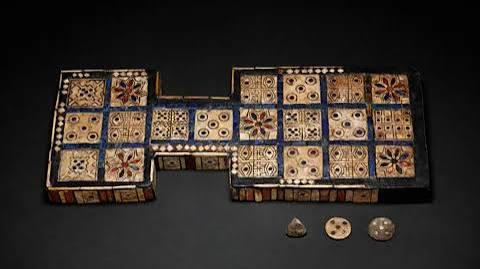

Ludo survived because it was never about the board — it was about the people around it. The mechanics are stripped-down enough that no amount of technological change has made them feel outdated. This article will explore where Ludo comes from, why simple luck-based games outlast complex ones, how it became a family ritual, what changed when it went digital, and what modern online Ludo looks like today.
What Is the Ancient History Behind Ludo and Where Did It Begin?
Ludo is derived from Pachisi, an ancient Indian board game dating back to at least the 6th century CE. Pachisi was played on a cross-shaped cloth board using cowrie shells as dice and wooden pieces as tokens. British settlers encountered it in the 19th century, adapted it, and patented the simplified version as “Ludo” in England in 1896 — from the Latin word meaning “I play.”
Key milestones in Ludo’s history:
- 6th century CE — Pachisi played in ancient India; referenced in Sanskrit texts and Mughal court records
- 16th century — Mughal Emperor Akbar played a life-sized version in his palace courtyard using human pieces as tokens
- 1890s — British adaptation of Pachisi produces the simplified Ludo format
- 1896 — Ludo patented in England; mass production begins
- 20th century — Spreads globally as a household game across Asia, Europe, and beyond
- 21st century — Digital versions bring Ludo to smartphones and online platforms
The core format — four colors, one board, a die, a race to home — has remained unchanged for fifteen centuries.
Why Do Simple, Luck-Based Games Have Such Unusual Staying Power?
They last because they have no learning curve. Anyone can play Ludo in minutes without prior knowledge, strategy study, or practice. That low barrier is the game’s most durable design feature.
Four reasons simple luck-based games hold up over time:
- Accessibility — no rules to memorize, no skill gap to close; new players can join any round immediately
- Perceived fairness — luck dominates enough that a child can beat an adult, which makes the game emotionally safe for everyone at the table
- Light decision-making — choosing which token to move, especially when a kick is possible, adds just enough agency to keep players engaged without adding complexity
- Short turns — no one waits long enough to disengage; the pace keeps the whole group present
The combination of randomness and minor choice is what creates a sustainable engagement loop across age groups and skill levels.
How Did Ludo Become a Social and Family Bonding Ritual Across Cultures?
Ludo became a bonding ritual because it requires nothing beyond a board and people willing to sit together. It scales to 2–4 players without rule changes, takes minutes to explain, and produces shared moments — the kicked token, the lucky six — that everyone at the table experiences at the same time.
Why Ludo embedded itself across different cultural contexts:
- Filipino households — associated with rainy afternoons and family weekends; the board coming out was a signal that everyone was present
- Indian families — rooted in Pachisi heritage; played during festivals and family gatherings with a natural cultural familiarity
- British households — introduced through colonial trade and mass production; a low-cost indoor game for families during long indoor days
- Global urban families — the digital revival reconnected players separated by distance through real-time multiplayer on smartphones
The game did not create these rituals. It became a container for them.
What Changed When Ludo Made the Jump From Physical Board to Digital Platform?
The core rules stayed the same. What changed was access — The players no longer needed a board, a table, or everyone in the same room. Mobile Ludo removed logistical barriers while keeping the social layer intact.
What the digital format changed:
- Real-time multiplayer — players from different locations join the same game instantly
- Faster pacing — automated dice rolls and animations cut dead time between turns
- New game modes — Turbo Mode and similar variations introduce speed and intensity not possible on a physical board
- Structured betting — pot contributions, kick-out bonuses, and home-arrival payouts tied financial stakes to each turn
- 24/7 availability — no setup required; a session can start any time without coordinating schedules or finding a board
The format expanded Ludo’s reach without replacing what made it work in the first place.
What Does the Modern Online Version of Ludo Actually Look Like?
Online Ludo runs on the same mechanics as the board game with a structured betting and reward layer added on top. It supports 2 to 4 players, each controlling 4 tokens on a cross-shaped track.
Key mechanics in the modern online format:
- Starting tokens — roll a six to move a token out of the yard and onto the track
- Turn order — players move clockwise; each turn ends after a single die roll (or two in Turbo Mode)
- Kick-out rule — landing on an opponent’s square sends their token back to the yard; the player earns a kick-out payout
- Home arrival — the first player to bring all tokens home wins; the format includes a first-home bonus in the reward structure
- Pot money — all players contribute to a shared pot each round; the winner collects the payout at the end
- Turbo Mode — uses 2 tokens and 2 dice per player, with 15 turns per game for a faster, compressed session
The rules are recognizable. The reward structure is what the online format adds.
If a Game Invented in the 6th Century Is Still Trending, What Does That Say About Us?
That we have not changed much. The things that made Pachisi work in a Mughal courtyard — the shared stakes, simple rules, luck, and people watching each other — are the same things that make Ludo work on a smartphone screen today.
Good games survive because they solve a problem that does not go away: getting a group of people genuinely engaged with each other at the same moment. Ludo has been doing that for fifteen centuries. The board got smaller, the dice went digital, the tokens became pixels — the reason anyone sits down to play is the same as it ever was.
Online Ludo is available on licensed gaming platforms in the Philippines. Whether you play for nostalgia or just to see if you can finally beat your family — it is worth a session.