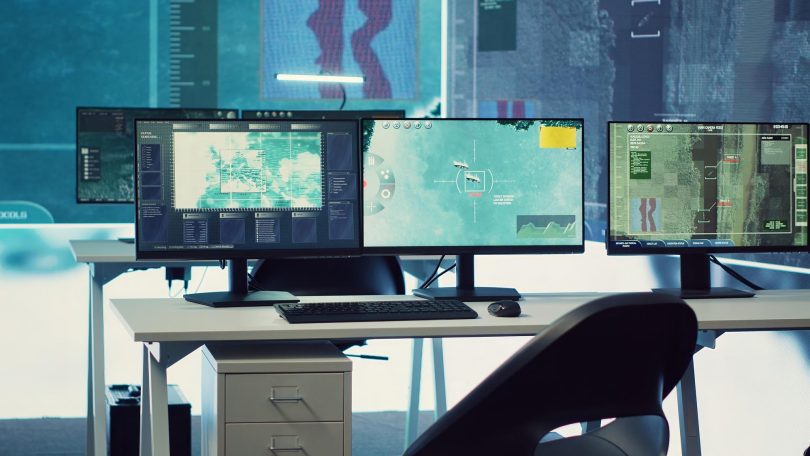

A Philips Future Health Index 2025 report, based on a company-commissioned global survey, found that 77 per cent of healthcare professionals said they lose clinical time because patient data are incomplete or inaccessible. In settings dense with monitors and records systems, the problem is not lack of information but the way it is organised. The result is a design failure imposed on clinicians, where time and attention are diverted from judgement to hunting, reconciling, and re-entering data.
Operating theatres, cockpits, and industrial control rooms share the same structural flaw: critical signals arrive through separate systems, each with its own interface, leaving the human at the centre to fuse them under pressure and in real time. The key distinction is between tools that are merely co-located on the same console and tools that are genuinely integrated into a single workflow in which monitoring, imaging, navigation, planning, and execution share one coherent architecture. Comparative human-factors work backs this up: a 2002 HFES study by Ververs, Dorneich, Good, and Downs found that integrated displays reduced button presses from 17.6 to 12.2 and lowered perceived workload from 4.9 to 3.9 compared with separate displays, indicating that integration can reduce interaction cost and cognitive load. The same conditional applies across domains: convergence improves conditions when practitioners retain transparent authority over the unified system and magnifies failure risk when that authority is undermined.
Genuine Integration in the Operating Theatre
Inside the operating theatre, intraoperative monitoring, imaging, navigation, planning, and execution tools have historically been separate devices, each with its own display and alarm patterns. A surgeon managing these is not simply using several tools; they are continuously performing synthesis work none of the devices support. The Joint Commission’s Sentinel Event Alert on “medical device alarm safety” describes how unmanaged alarm defaults, similar-sounding alerts, and failures to respond can produce “alarm fatigue” and direct patient risk, framing alarms as a system-design and governance problem rather than a matter of individual vigilance. Integrated intraoperative workflows are intended to address exactly this failure mode by turning competing signals into a single, ordered cognitive environment.
Dr Timothy Steel, a neurosurgeon and minimally invasive spine surgeon at St Vincent’s Private Hospital, encounters that design problem in a high-volume spine programme. His service at St Vincent’s Private incorporates the NuVasive Pulse digital surgery platform, which the hospital introduced in September 2022 as the first in Australasia to offer it. Pulse combines neuromonitoring, imaging, navigation, planning, and rod bending into one digital workflow for spine procedures, so functions that previously lived on separate machines now operate within a common architecture. Instead of reconciling five independent systems at the table, Steel can work inside a single environment that helps reduce variability and radiation exposure while leaving clinical decisions and overall authority with the surgeon. The gain is not just screen consolidation; it is a redesign of what the surgeon’s attention is spent on during critical moments.
The same structural shift is visible in new intraoperative platforms beyond a single hospital. In April 2026, GE HealthCare announced a digital integration that lets its bkActiv intraoperative ultrasound system plug directly into Medtronic’s Stealth AXiS surgical navigation system, creating a unified workflow for cranial procedures in which real-time ultrasound and navigation operate together without disrupting established routines. Trade press coverage describes the integration as a way to give neurosurgeons live visualisation while keeping planning, navigation, and robotics in one setup, including for issues such as brain shift. Taken alongside the NuVasive Pulse environment in Steel’s programme, this points to a broader direction: genuine surgical convergence is becoming an infrastructure layer that reorganises the cognitive environment of the operating team rather than a cosmetic upgrade to individual devices.
Safe or Dangerous Convergence
Commercial aviation shows the same convergence pressures and the consequences when integration proceeds without transparent operator authority. An April 2026 analysis titled “Boeing reworks cockpit automation around explainable, pilot-overridable systems” describes how, after the 737 MAX crisis, Boeing is redesigning cockpit automation so pilots can understand and override it, with revised alert prioritisation, sensor fusion across angle-of-attack, GPS, inertial reference, and ADS-B inputs, and larger integrated displays. The move responds to the earlier Maneuvering Characteristics Augmentation System (MCAS) implementation, which fused sensor data and moved the stabiliser without adequate crew awareness or straightforward override, contributing to two catastrophic crashes and a worldwide grounding. The FAA’s Joint Authorities Technical Review on 737 MAX certification highlights the MCAS-related human-factors and interface assumptions. An attachment to the Ethiopia Accident Investigation Bureau’s interim report notes that the “MCAS system will reset after a 5 second delay” following certain pilot trim inputs. Together, they describe an integrated system whose internal logic and authority boundaries were not sufficiently visible to the people meant to be in charge of it.
Indonesia’s National Transportation Safety Committee, KNKT, which investigated one of the 737 MAX accidents, captured the core condition for safe convergence in a safety recommendation reproduced in the FAA’s 737 MAX return-to-service review: “The flightcrew should have been provided with information and alerts to help them understand the system and know how to resolve potential issues.” For integrated environments of any kind, that is the threshold: unless the unified system exposes enough information and alerting for operators to understand and act on its behaviour when it diverges from expectations, convergence functions as a risk multiplier rather than a safeguard.
Industrial Scale Integration and Governance
Large energy and resources operations face the same structural fragmentation familiar from hospitals and cockpits. Live plant data, process control systems, condition monitoring, and safety instrumentation have often been implemented as separate layers, each with its own screen and alarm philosophy. Control-room operators then carry the burden of mentally combining these feeds to maintain a picture of what the plant is doing.
The August 14, 2003 U.S.–Canada blackout is a widely cited warning about what happens when integrated operations lack adequate reliability assurance. The U.S.–Canada Power System Outage Task Force’s final report records that FirstEnergy’s SCADA/EMS alarm and logging software failed, so operators’ consoles received no new alarms or alarm logs and they were “working under a significant handicap.” The same report notes that the EMS provided no mechanism to alert operators that the alarm system itself had failed, leaving them to assume that a quiet screen meant a stable grid. Integrated monitoring that cannot be monitored for its own failure becomes a single silent point of exposure.
In this industrial context, Emma Eltringham, Principal AI Product Manager at Woodside Energy, works on the same integration problem from a different angle. She contributed to Fuse, Woodside’s digital twin project that connected live plant data with three-dimensional visualisations to support operational decision-making. That experience now informs Eltringham’s leadership of Lumina, Woodside’s internal AI ecosystem that hosts more than 40 enterprise AI agents within a common architecture for data and tooling.
What Eltringham’s role makes clear is that large-scale integration is as much a governance exercise as an engineering one. In that frame, digital twins and AI ecosystems are not just efficiency tools; they are structures that reassign who sees what, when, and with which ability to intervene. The benefit of convergence in these environments depends on whether organisations design oversight, accountability, and operator training around that new distribution of authority, not simply on whether they have installed an impressive-looking platform.
The Changing Shape of Risk
As workflows converge onto unified platforms, risk does not disappear; it changes shape. When monitoring, imaging, navigation, and execution all rely on a single integrated system, any failure or degradation of that system becomes immediately consequential. Endsley and Kiris’s 1995 work on the out-of-the-loop performance problem found that automation can lower situation awareness and impair decision performance precisely when automation fails and rapid human takeover is required. Aviation regulators treat this as an operational concern rather than a theoretical one: an FAA Safety Alert for Operators, SAFO 13002, urges airlines to promote manual flight operations, when appropriate, so pilots maintain knowledge and skills in highly automated environments.
Those risks create clear obligations around training and fallback competence. In integrated clinical environments, where a single platform may govern neuromonitoring, navigation, and execution simultaneously, the consequences of a system failure mid-procedure are immediate and direct. The SAGES/MIRA Consensus Panel’s guidance on robotic surgery training and credentialing states that “this training must include how to safely and rapidly remove the device in an emergency, what to do if the system stops responding,” underscoring that rehearsed responses to foreseeable failures are part of safe practice, not an optional extra. The same obligation applies wherever deep integration has made a platform central to the work: aviation, surgery, and industrial operations all require practitioners who can act competently when the unified system cannot.
Experience in highly automated environments has shown that when a converged control system can act on fused sensor inputs without operators clearly understanding when, why, or how it is intervening, the risk is not just nuisance behaviour but loss of effective authority. The design obligation that follows is to make automation explainable and straightforwardly overridable so that integrated systems show their logic and limits rather than hiding them. In any converged environment, opaque behaviour from a central platform does more than inconvenience operators; it removes their ability to exercise judgement at the moment it is most needed.
Because genuine convergence embeds core work inside a shared digital workflow, the depth of integration and the scale of potential harm rise together as shallow aggregation of data streams into a dashboard creates some dependency but deep integration, of the kind that actually reduces cognitive fragmentation for clinicians, pilots, and plant operators, also creates reliance on the integrity, transparency, and recoverability of that platform. A realistic view of convergence treats this concentrated risk profile as part of the design brief, not an argument for clinging to fragmented systems that were already failing the people who depend on them.
Authority at the Interface
Across operating theatres, industrial control rooms, and cockpits, the same pattern repeats. Fragmented devices and software push the work of integration onto the practitioner, as captured by the clinicians in Philips’ survey who described losing time to inaccessible or incomplete data. Integrated surgical platforms such as the NuVasive Pulse environment in Steel’s spine programme, and the combined ultrasound–navigation workflow from GE HealthCare and Medtronic, show how convergence can reorganise that work so monitoring, imaging, and execution live in one coherent architecture. Industrial digital twins and AI ecosystems like Fuse and Lumina do something structurally similar for live plant and enterprise data, while the 737 MAX crisis remains a reminder of how integration can fail.
That condition is transparent, retained human authority at the interface. Convergence is beneficial when operators can see what the system is doing, understand its logic and limits, and override or reconfigure it when circumstances demand. Under those conditions, unified workflows reduce cognitive fragmentation and allow expertise to be spent on decisions rather than on stitching together partial pictures. When those conditions are absent, convergence can create brittle, opaque failure modes in which a single, complex interface becomes the point where problems concentrate faster than operators can detect or correct them.
The clinicians who reported lost clinical time were giving a design diagnosis rather than a complaint about technology in general. The remaining task is to ensure that these converged systems are built and governed so that the people at their centre keep the authority and insight they need to act when the system reaches its limits.